GRP Systems
GRP Sandwich Gratings
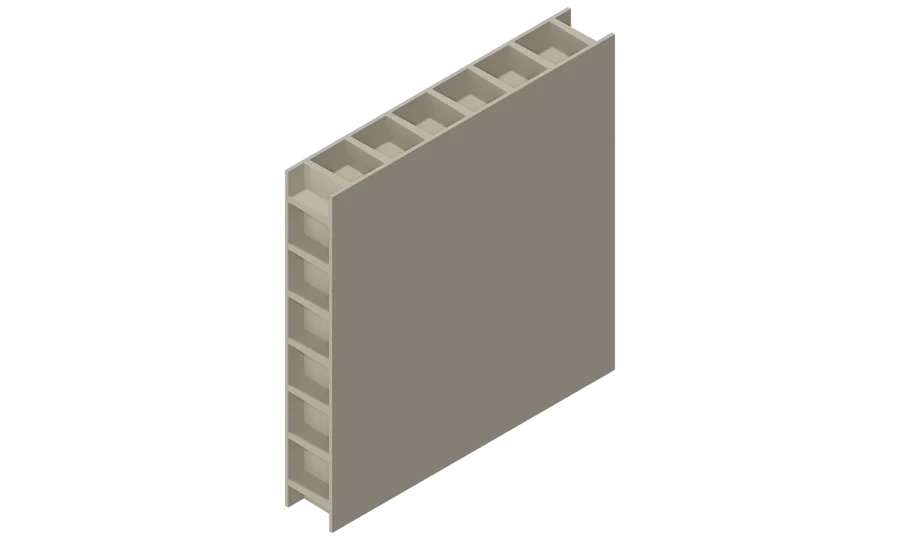
GRP sandwich gratings consist of a load-bearing GRP grating laminated between two GRP panels—one on the upper side and one on the underside. The standard panel thickness is 3 mm, with optional thicknesses of up to 5 mm available.
Your contact persons GratingsAs with the GRP Safety Floor, the grating surface is ground prior to lamination to ensure optimum adhesion.
All moulded GRP gratings can be used as the structural core of the sandwich system.
GRP Resin Matrix Systems
Different resin matrix systems are available to optimise corrosion resistance, temperature performance and fire behaviour for specific applications.
Orthophthalic (OPR)
Polyester resin for mildly corrosive environments.
- Orthophthalic polyester resin
- Flame-retardant
- Halogen-free (non-toxic)
- Self-extinguishing
- HDT (A): 80 °C
- Martens heat distortion temperature: 160 °C
Isophthalic (IPR) – Standard
Universal-purpose polyester resin.
- Isophthalic polyester resin
- Flame-retardant
- Halogen-free (non-toxic)
- Self-extinguishing
- HDT (A): 120 °C
- Martens heat distortion temperature: 160 °C
Vinyl Ester (VER)
Vinyl ester resin for maximum chemical resistance
- Vinyl ester resin
- Flame-retardant
- Halogen-free (non-toxic)
- Self-extinguishing
- Heat Deflection Temperature (HDT A): 120 °C
- Martens heat distortion temperature: 180 °C
Vinyl ester resin is the preferred choice where exceptional chemical resistance, enhanced temperature resistance, and superior impact and fatigue strength are required. It is ideally suited for high-performance GRP gratings designed for use in the most demanding industrial environments.
Phenolic Resin (PHR)
Maximum fire protection
- Phenolic resin
- Flame-retardant
- Self-extinguishing
- Extremely low smoke generation
- Heat Deflection Temperature (HDT A): 160 °C
- Martens heat distortion temperature: 180 °C
Phenolic resin offers outstanding fire performance thanks to its exceptional heat resistance, minimal smoke generation and very low toxicity of combustion gases. In the event of a fire, flame propagation is significantly reduced, making it the preferred solution for applications with the highest fire safety requirements.